


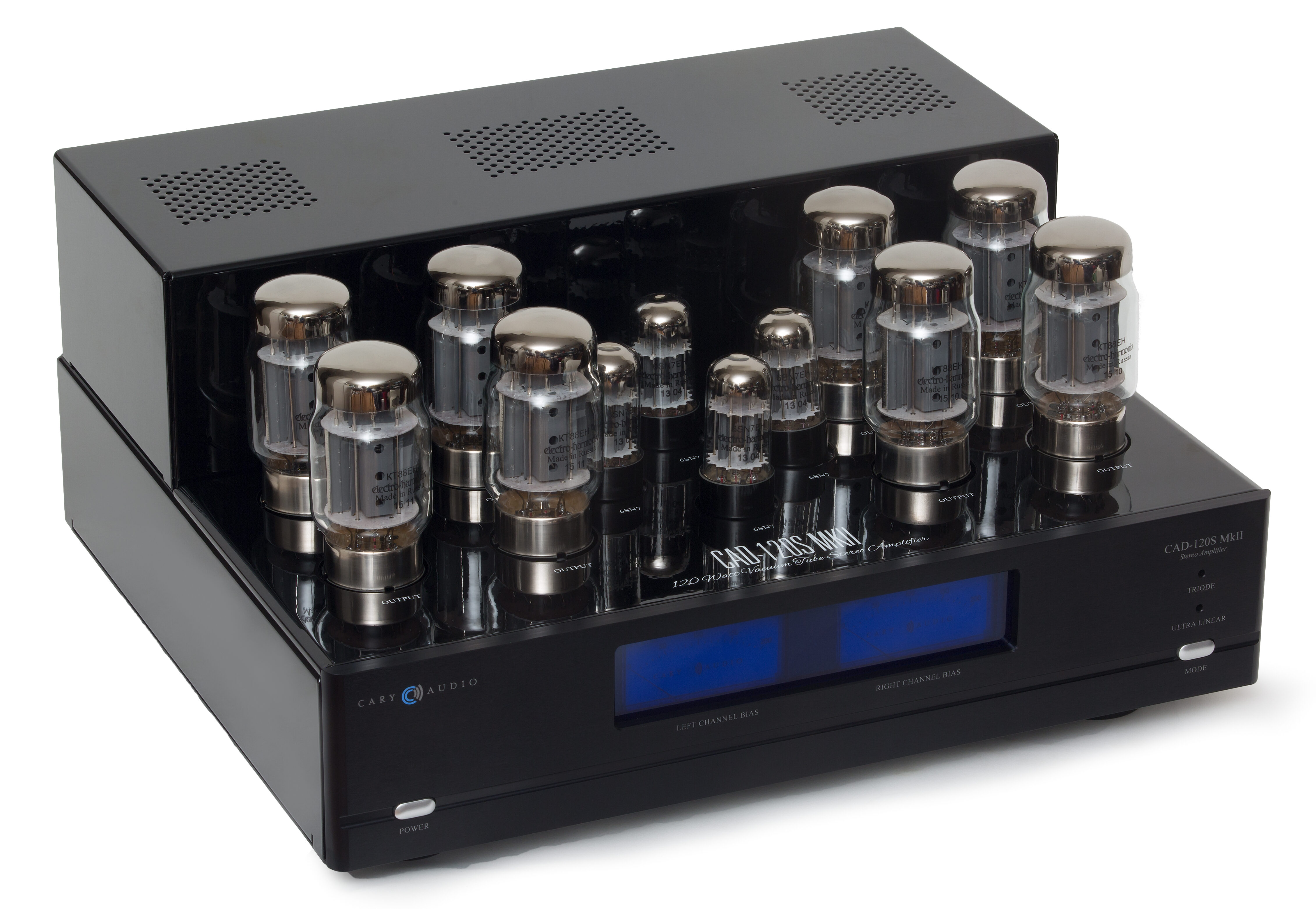
When longtime Cary Audio customer John Brown reached out to share his experience with the CAD-120S MkII, he admitted he may have gotten a little carried away. After more than 20 years, three Cary Audio amplifiers, and over 300 hours with his newest addition, he had a lot to say. From his first SLI-80 to the SLI-100 and now the CAD-120S MkII, John takes us through the evolution of his system and explains why he believes this is the last amplifier he will ever need.
Bottom Line
The Cary Audio CAD-120S MkII is a glorious, natural-sounding amplifier. The straightforward design and well-engineered, handcrafted build provide a fantastic musical experience. This amplifier does not disappoint. I will never need to buy another amplifier again.
The Prelude
The old saying continues to ring true… the third time is the charm. The CAD-120S MkII is the third amplifier I have purchased from Cary Audio in the past 20 years. The good news for me is that this will be the last amplifier I will ever need to purchase.
Back around 2005, my Counterpoint preamplifier needed new tubes. While it had an amazing phono preamp stage, I had converted to CDs/SACDs and was done with the hassle of playing records. I was toggling between a Conrad-Johnson MV45 and a Sonic Frontiers SFS-40 amplifier within my system, both utilizing EL34 output tubes. I was looking to simplify my stereo system by removing the preamplifier component from the signal path and increasing the power output.
Enter my first Cary Audio purchase… the SLI-80 integrated amplifier. A highly versatile amplifier accommodating real-time switching between Triode and Ultralinear modes and capable of easily pushing 4- or 8-ohm speaker loads. I loved it! I enjoyed it for 15 years!! I upgraded the output tubes to Gold Lion KT88s, and the amplifier transformed into a world of smooth, warm-sounding musical beauty. I sold it to a close friend who somehow convinced me I should not lug a 42-pound amplifier and big speakers 800 miles cross-country to my new house. Well, now the amp is over 20 years old, and he continues to enjoy it on a nightly basis. It still sounds amazing!
Finding myself without an amplifier, having moved to North Carolina, and looking for a wee bit of extra output power to push my new speakers, I contacted Billy Wright at Cary Audio, and we reviewed the newly released SLI-100 amplifier. I ordered a unit with the upgraded rectifiers, Greyhill switch, and WBT binding posts. I was able not only to pick it up directly from the factory but also to listen to it in Cary Audio’s demo room before taking it home. WOWZERS… the extra oomph from the KT150 tubes was just what my new speakers needed. The smoother jazz brass and magical female vocals were an unexpected bonus. I was happy. I was very happy with a great-sounding amplifier. Everything was great… I had an awesome-sounding musical system.
And then… I upgraded my primary Rega CD player to a gently used Ayon CD-35s. I thought, “This is going to sound AMAZING!!” I connected everything, turned on the Ayon, powered up the SLI-100, and let the system warm up for a good 30 minutes. I put in a CD, hit play… and WHOA! MUDDY!!! The Ayon sounded HORRIBLE compared to my Rega. What the heck??!!?? Okay, okay, I was not sure how many hours were on the Ayon. Maybe it just needed new tubes. I ordered a fully matched and tested tube set directly from Ayon. When I opened the unit to swap out the tubes and take a look at the circuit design, the “AH-HAAA!!” moment occurred!
I discovered the Ayon has an analog stepped attenuator preamp output. OHHH!!! I had entered the hi-fi realm where impedance matching between components had become critical to the sound quality. GOT IT… I had to vary the Ayon’s analog output and simultaneously adjust the SLI-100’s input potentiometer (volume knob) to get the desired volume while matching the amp’s anticipated input impedance. Now… WOW!! Yes, the Ayon sounds amazing. The SLI-100 continued to sound amazing. The Ayon made a great-sounding SLI-100 amplifier sound even better. But what a PAIN having to constantly tweak both units to get to the desired volume and back into the “great sound zone.”
Well, since I can change the volume via the Ayon CD player (not an anticipated feature when I purchased the unit) and no longer need to switch between different CD players, after five pleasurable years, I no longer need an integrated amplifier. I will go back to the world of direct amplifiers again. YEAH!!
I zapped a note over to Cary Audio explaining my situation, and they quickly offered a highly generous trade-in allowance for my SLI-100 toward the purchase of a new CAD-120S MkII.
I was fortunate enough to be greeted by Billy when I stopped by Cary Audio’s location in Cary, North Carolina, to drop off my SLI-100 and pick up my new CAD-120S MkII with upgraded MCap SUPREME EVO SilverGold capacitors, Hexfred rectifiers, and WBT speaker binding posts. We had a fun chat, but I quickly ran home to play with my new toy!!
Review of the CAD-120S MkII
I could not wait to hook up my new amp and listen to it. Upon the initial power-on, I noticed a few slight sonic improvements, but my socks were not being knocked off like they were when I came home with the SLI-100. Hmmmm… after 50 hours of playing time, I almost called Cary Audio to ask for my SLI-100 back.
Being patient and giving the amp a little more time, right around 75 hours, the amplifier started sounding much better. Tighter bass response, a stabilized soundstage, and the ever-so-slight shrillness in the highs smoothed out… all right, NOW I am starting to get impressed. In total fairness, Cary Audio does recommend at least a 100-hour break-in period. After 150 hours of listening (and now well over 300 hours), there was no denying that the CAD-120S MkII is clearly a superior-sounding amplifier.
My main criterion for how well a stereo system sounds is its ability to reproduce the sound of a live performance, be it meticulously recorded in a studio environment or on a performance stage with an audience. A tall task, given the vast range of musical genres I enjoy listening to, combined with a multitude of recording techniques and recording qualities.
Cary Audio amplifiers have a unique ability to create a believable and stable soundstage. Believable because all the instruments are placed appropriately not only across a wide left, center, and right spectrum but also with a sense of depth, from farther back to closer to the front. Stable because the instrumentation does not wander around the soundstage. As the volume and intensity vary, the instruments remain in their respective locations.
The CAD-120S MkII clearly provides the broadest and deepest soundstage of all the amplifiers I have owned. Listening to full symphony recordings brings me right back to sitting in the center section of Lincoln Center’s Alice Tully Hall… violins placed in the left front, cellos on the right with the violas slightly behind, basses far right, woodwinds in the middle and in front of the brass section, percussion way in the back and on the right, with mallets, piano, and harps to the rear on the left.
This amplifier maintains the soundstage across my wide gamut of musical genres, all the way over to live rock and roll. The Who’s Live at Leeds brings Keith Moon’s overpowering drumming to center stage. While I am not a huge fan of Pete Townshend’s selection of Hiwatt guitar amplifiers for the show, the CAD-120S MkII accurately reproduces the guitar tone to the point that it feels like Pete’s amplifiers are sitting right in my living room. Oh, and then we have Roger Daltrey’s vocals… incredible!
Speaking of vocals, Cary Audio does a remarkable job of conveying a singer’s emotion, pitch, projection, and inflection without coloration. I will admit, the Cary SLI-100 amplifier does something magical with female voices. The CAD-120S MkII does not disappoint, though… the vocalist’s texture is accurately present, and subtle intonations are clearly audible.
The CAD-120S MkII does all of the above while wonderfully combining tight bass (Sly & Robbie never sounded tighter), non-shrill treble (cymbals are crisp and shimmery but not sharp), and pleasantly balanced midrange. Overall, this amplifier provides a neutral sound that is authentic to the original recording and pleasing to listen to nonstop for hours. It is a glorious, natural-sounding amplifier. Sorry, Billy… this is the last amplifier I will ever need to purchase.
Listening in Triode or Ultralinear mode?? AHHH!! A bit of a major dilemma here. Both modes sound great, even at any given volume. Both modes have a slightly different sound, and I am having a hard time deciding which I like better. I think the answer is BOTH.
Triode mode favors softer listening, late nights, smooth jazz, a broader soundstage, and an overall warmer tone. Ultralinear mode adds a little extra punch to rock and roll, higher volume, sharper and more pronounced bass, and slightly brighter high notes. While the soundstage is somewhat narrower, it is brought forward with more presence. I have been pleased listening to the same songs in both modes, leaving me perplexed as to whether one sounds better than the other. Different sounding, both great.
And for us tube rollers… the CAD-120S MkII can accommodate KT88, 6L6, 6CA7, KT66, 6550C, KT90, KT99, or EL34 output tubes. THANK YOU to Cary Audio for putting an output-tube bias meter right on the front. Oh gosh, it is SO much easier to make sure both channels are equally adjusted. No more having to bring out the Fluke multimeter, screwdriver, and special plug to verify that the tube bias is set correctly. When rolling output tubes, the bias can be recalibrated quickly and monitored with ease.
Cary Audio provides Electro-Harmonix tubes with the amp. Not a bad choice. They are reliable and great sounding. I have a preference for a slightly warmer sound, and having had success with Gold Lion KT88s back in the day with my SLI-80, I upgraded the factory-default EH KT88s to a set of Gold Lion tubes. Yup, subtle but noticeable audio differences. I found that the default EH tubes actually produce better bass notes, but the Gold Lion tubes have an ever-so-slightly warmer overall musical tone with gentle-sounding highs.
Okay, I am getting nitpicky about variations in the amplifier’s sound, but the fun part is that tube rolling is simple, and the bias can be adjusted quickly. I am looking forward to picking up 6550C and KT99 tubes soon and experiencing the overall sound differences. And yes, as outlined in the owner’s manual, listening at high volumes while watching the bias needles dance is fun!!
The System
Cary Audio CAD-120S MkII amplifier, Ayon CD-35s CD player, Bowers & Wilkins 803 D3 speakers, Furman DLP-Plus DMC power conditioner, Signal Cable power cords, Signal Cable XLR interconnects, AudioQuest William Tell speaker cables, and SolidSteel equipment rack.
Ready to experience the CAD-120S MkII for yourself? Learn more about its design, features, and specifications on the Cary Audio product page. Customers in the United States and Canada can purchase the CAD-120S MkII factory-direct through CaryDirect.